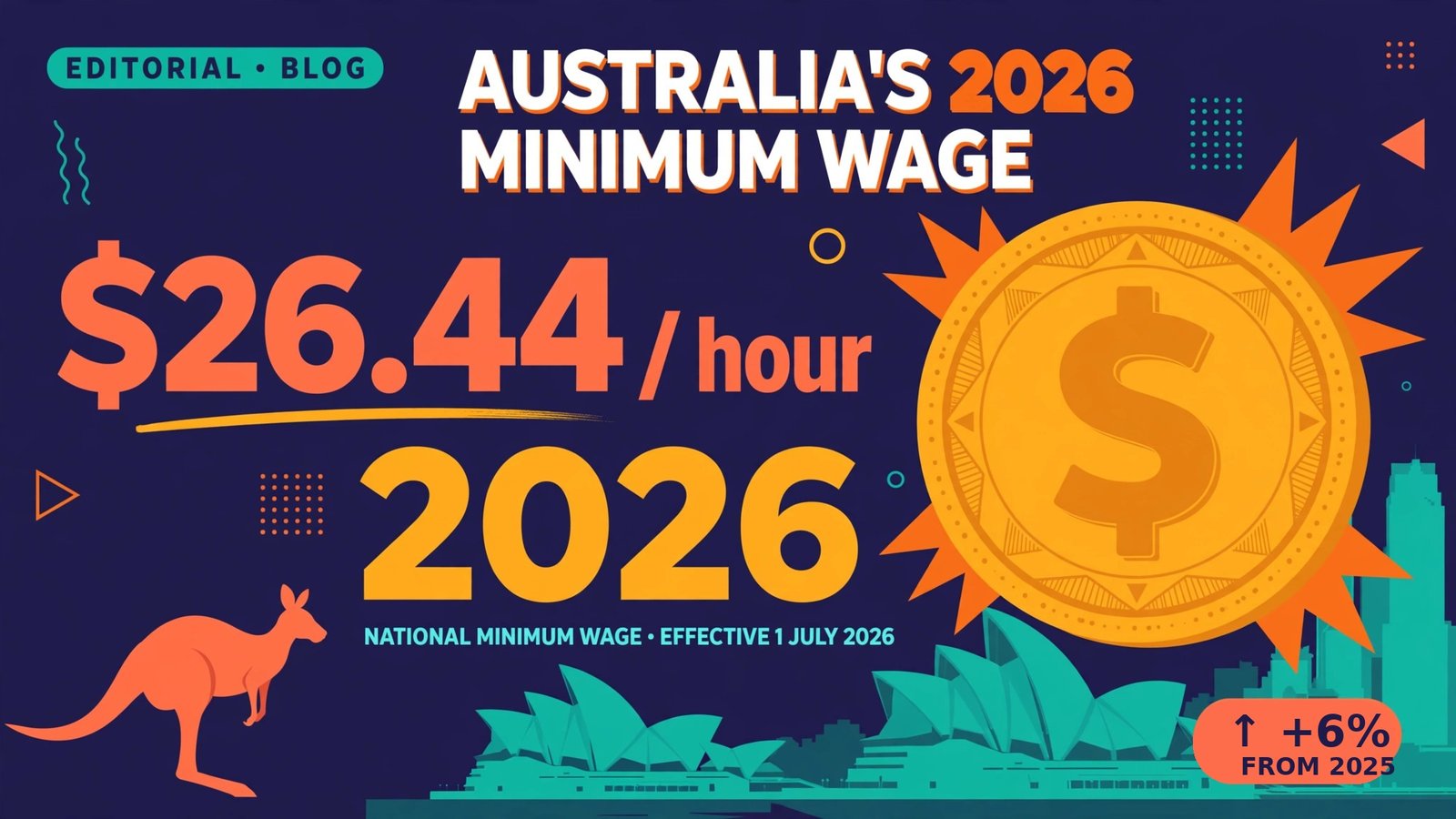
The australia minimum wage 2026 figure is one every worker should know: $26.44 an hour, or $1,004.90 a week for a full-time 38-hour week — the first time the weekly minimum has ever crossed the $1,000 mark. Effective from the first full pay period on or after 1 July 2026, it is the national minimum wage in Australia — but casual loading, junior rates, award coverage, tax and super all change what that number means in your pocket.
Want your exact take-home pay?
The minimum wage is your gross figure — see what actually lands in your bank account with our free Australia take-home pay calculator, which handles the 2026-27 tax brackets, Medicare levy and super for you.
Australia minimum wage 2026: the full rate breakdown
The Fair Work Commission handed down its Annual Wage Review 2026 decision on 2 June 2026, and the national minimum wage rose 6%, from $24.95 to $26.44 an hour. Here is what the 2026 minimum wage looks like at every pay frequency, before tax:
- Per hour: $26.44
- Per day (7.6 hours): $200.94
- Per week (38 hours): $1,004.90
- Per fortnight (76 hours): $2,009.80
- Per year (52 weeks): $52,254.80
Australia uses a 38-hour standard full-time week, not 40 — and the new rates legally apply from the start of your first full pay period on or after 1 July 2026, not 1 July itself. If your pay period starts on a Wednesday, the new rates begin that Wednesday.
What changed on 1 July 2026
The 2026 increase was the biggest in several years: last year’s rise was 3.5% (to $24.95) and 2024’s was 3.75%. It had two layers:
- National minimum wage: up 6% to $26.44 an hour ($1,004.90 a week), for award-free employees.
- Modern award minimum rates: up 4.75%, affecting around 2.8 million Australians — about 21% of the workforce — who are paid at a modern award rate.
There was also a structural fix for the lowest-paid workers: the lowest award classification (C13) was aligned with the national minimum wage, and a new entry-level floor of $25.74 an hour ($978.10 a week) was set for roles lasting no more than six months. On top of wages, 1 July 2026 also brought Payday Super — employers must now pay super at the same time as wages rather than quarterly.
Casual minimum wage in 2026: $33.05 an hour
Casuals receive a 25% loading on top of the base rate to compensate for the absence of paid leave and other entitlements. From 1 July 2026, that means a minimum of $33.05 an hour for casual employees on the national minimum wage ($26.44 × 1.25).
That loading is not a bonus — it is the trade-off for no annual leave, no paid sick leave and no paid public holidays. If you work irregular shifts, casual penalty rates for evenings, weekends and public holidays stack on top of this base, so your real hourly rate can be considerably higher on certain shifts.
Junior and entry-level rates: less than the adult minimum
The $26.44 figure is the adult rate for employees aged 21 and over. Award-free junior workers are paid a percentage of the adult rate: 36.8% for under-16s ($9.73 an hour), 47.3% at 16 ($12.51), 57.8% at 17 ($15.29), 68.3% at 18 ($18.06), 82.5% at 19 ($21.82) and 97.7% at 20 ($25.84), reaching the full $26.44 from age 21.
Most junior workers are covered by a modern award rather than the award-free rates above, and award junior percentages can differ — so always check the specific award for your industry.
Who actually gets the national minimum wage?
The national minimum wage is the legal floor, but it is not what most Australians earn. It applies only to employees who are not covered by a modern award or enterprise agreement. Most minimum-wage earners fall under one of more than 120 modern awards — retail, hospitality, healthcare, construction and others — and those award rates sit above the national minimum.
An important check: if you are paid exactly $26.44 an hour and your job fits a modern award, you may be underpaid. Use the Fair Work Ombudsman’s free Pay and Conditions Tool to check the correct rate for your classification, age and employment type.
Minimum wage take-home pay: what you actually keep in 2026-27
Gross pay is not what you keep. A full-time minimum wage worker earns $52,254.80 a year before tax. Through the 2026-27 resident tax rates (15% between $18,201 and $45,000, then 30%), plus the 2% Medicare levy and the low income tax offset:
- Income tax: ≈ $6,196, reduced by ≈ $216 low income tax offset → ≈ $5,980
- Medicare levy (2%): ≈ $1,045
- Total tax + levy: ≈ $7,025
- Take-home pay: ≈ $45,229 a year → ≈ $869.80 a week → ≈ $3,769 a month
These figures are approximate — your real take-home depends on deductions, offsets and other income. One helpful change for 2026-27: the tax rate between $18,201 and $45,000 dropped from 16% to 15% on 1 July 2026, worth an extra ≈ $268 a year versus last year’s settings. To get a personalised number, run it through our free Australia take-home pay calculator.
Super on the minimum wage: another $6,270 a year
On top of your wages, your employer must pay superannuation guarantee of 12% of your ordinary time earnings. For a full-time minimum wage worker, that is 0.12 × $52,254.80 = ≈ $6,271 a year into your super fund — paid by your employer on top of your pay, not deducted from it.
Frequently asked questions
What is Australia’s minimum wage in 2026?
Australia’s national minimum wage from 1 July 2026 is $26.44 an hour, or $1,004.90 a week for a full-time 38-hour week ($52,254.80 a year). It applies to adult employees who are not covered by a modern award or enterprise agreement.
What is the casual minimum wage in Australia in 2026?
Casual employees entitled to the national minimum wage must receive at least $33.05 an hour from 1 July 2026. That is the $26.44 base rate plus the standard 25% casual loading, which compensates for not receiving paid leave entitlements.
How much of the Australian minimum wage is take-home pay?
A full-time minimum wage worker earning $52,254.80 a year in 2026-27 keeps approximately $45,229 after income tax (including the low income tax offset) and the 2% Medicare levy — about $869.80 a week. Exact take-home depends on deductions, offsets and other income.
When does the 2026 minimum wage increase start?
The new rates apply from the first full pay period starting on or after 1 July 2026, following the Fair Work Commission’s Annual Wage Review decision handed down on 2 June 2026. The next review decision is due in June 2027.
Figures in this article are based on the Fair Work Commission’s Annual Wage Review 2026 decision and the ATO’s 2026-27 resident tax rates. If you earn above the minimum, see how overtime at 1.5x or 2x your rate boosts your pay with our overtime pay calculator — and before your next salary conversation, use our pay raise calculator to see exactly what a pay bump is worth.