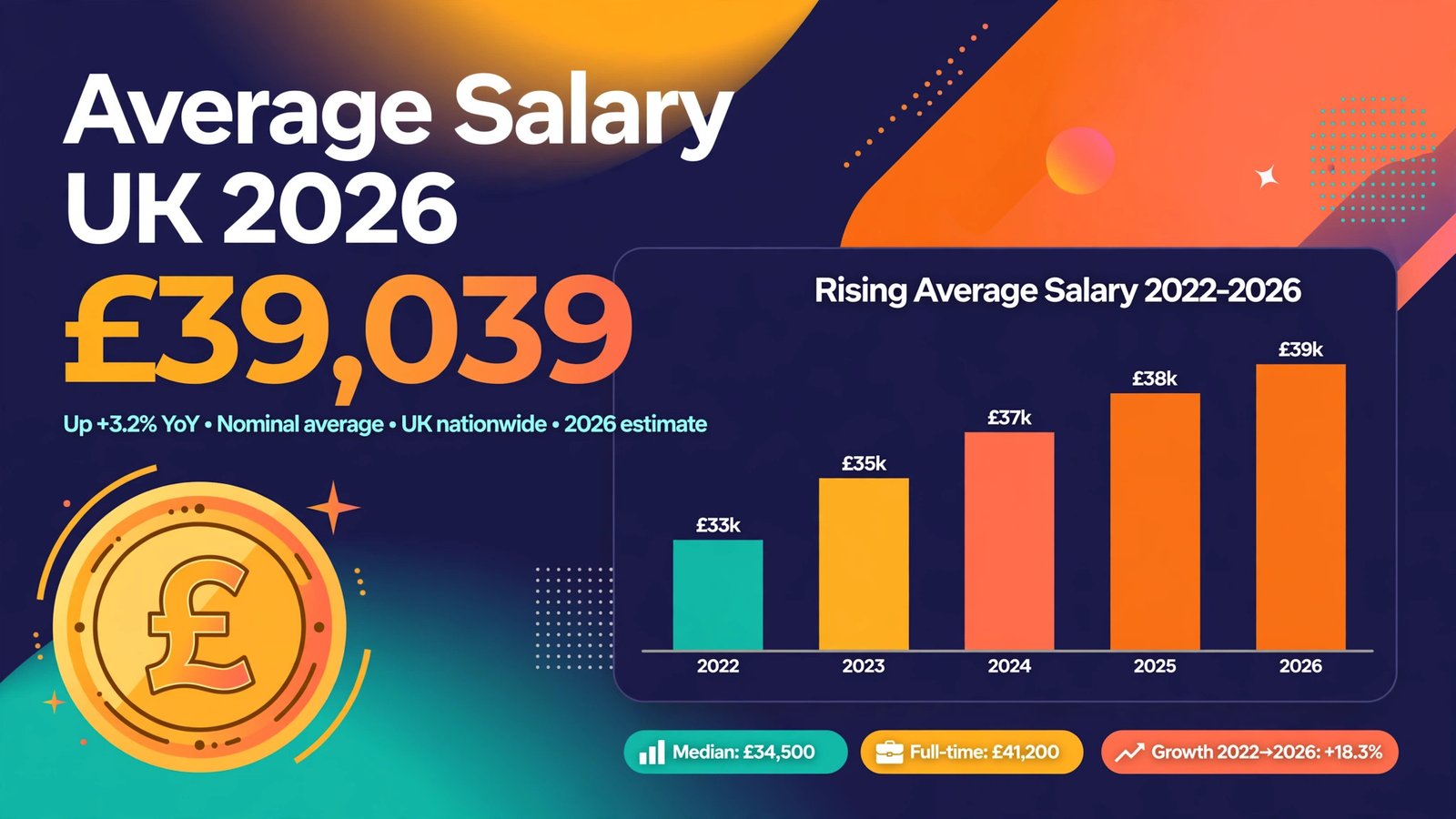
What is the average salary in the UK in 2026? The short answer: the median UK salary is £39,039 a year. That is the latest official figure, from the Office for National Statistics’ Annual Survey of Hours and Earnings (ASHE), which measured pay in April 2025 and was published in October 2025. It rose 4.3% in a year, up from £37,439 in April 2024.
But the headline number only tells part of the story. Your actual earnings depend on your age, your region, your industry — and, crucially, what is left after tax. This guide breaks down what Brits really earn in 2026, and what those numbers mean for your pay packet.
See what the average salary is worth after tax
The median salary is £39,039 gross — but what lands in your bank account each month? Enter any salary into our free UK take-home pay calculator to see your exact monthly take-home, income tax and National Insurance in seconds.
Median vs mean: why “average salary” can be misleading
When people quote an “average salary”, they usually mean one of two very different numbers:
- Median salary: £39,039. The midpoint — half of full-time employees earn less, half earn more. This is the figure the ONS puts at the centre of its reporting.
- Mean salary: £48,512. Every salary added up and divided by the number of workers. A small number of very high earners in finance, tech and senior management pull this figure upward.
The median (£766.60 a week) is the more honest description of what a typical British worker earns. Whenever a headline quotes an “average” without saying which, it is usually the mean — which flatters the picture by roughly £9,500.
UK average salary by age
The ONS age breakdown shows earnings peaking in your forties, then tapering off. Here are the median full-time salaries by age group from the latest ASHE data (provisional figures):
| Age group | Median salary |
|---|---|
| 18–21 | £23,596 |
| 22–29 | £32,347 |
| 30–39 | £40,668 |
| 40–49 | £44,244 |
| 50–59 | £41,866 |
| 60+ | £36,467 |
Earnings climb fastest between your twenties and thirties, peak in the 40–49 bracket, then ease off — partly because older workers are more likely to work part-time. If you are under 30 and earning around £32,000, you are right on the national median for your age group.
UK average salary by region
Where you live matters enormously. London is in a league of its own: the median full-time salary in the capital sits around £47,000–£53,000, roughly a quarter above the national median. The South East is next at approximately £40,000. At the other end of the scale, median salaries in the North East, Wales and Northern Ireland cluster around £30,000–£31,000.
Of course, the London premium comes with a cost — housing alone can wipe out the salary gap. Before relocating for a higher wage, convert the offer into an hourly or monthly figure with our hourly-to-salary converter and compare it against the cost of living honestly. These regional figures are estimates pieced together from ONS releases and industry surveys, and vary by source.
UK average salary by industry
Industry is the single biggest lever on your earnings. Based on recent industry salary surveys and ONS data (estimates, and they move every year):
| Industry | Typical median salary |
|---|---|
| Finance & insurance | ~£52,000 |
| Technology & software | ~£50,000 |
| Legal services | ~£46,000 |
| Engineering | ~£44,000 |
| Healthcare (NHS clinical) | ~£42,000 |
| Education | ~£38,000 |
| Marketing & communications | ~£36,000 |
| Retail management | ~£28,000 |
| Hospitality & tourism | ~£24,000 |
The spread between the top and bottom rows is more than £28,000 — which is why career switchers obsess over these tables. Just remember they are medians within each sector; a top hospitality manager can out-earn a junior analyst in finance.
The UK minimum wage in 2026
The legal floor under all these figures moved on 1 April 2026. The National Living Wage (for workers aged 21 and over) rose 4.1% from £12.21 to £12.71 an hour, under the National Minimum Wage (Amendment) Regulations 2026. The 18–20 rate rose 8.5% to £10.85, and the 16–17 and apprentice rates rose to £8.00. A full-time worker on a standard 37.5-hour week at the new National Living Wage earns around £24,785 a year gross.
Work regular extra hours on top of your salary? Your effective hourly rate may be lower than you think — our overtime pay calculator shows what those additional hours are really worth.
What does the average salary mean after tax?
Gross pay is only the beginning of the story. On a £39,039 salary in England in the 2026/27 tax year, you would take home roughly £31,600 a year — about £2,635 a month — after income tax and National Insurance, before any pension or student loan deductions.
Note that income tax thresholds remain frozen until at least April 2028, so every pay rise pushes a slightly larger share of your income into tax — an effect economists call fiscal drag. If you have recently had a salary bump, run it through the UK take-home pay calculator to see how much of the rise you actually keep. Freelancers can flip the comparison the other way: £39,039 a year is equivalent to roughly £20 an hour on a 37.5-hour week — use our freelance rate calculator to work out what day rate would beat it.
Is your salary a good salary in the UK in 2026?
Some rough percentiles to place yourself (estimates, as exact distribution data lags):
- £30,000 — below the median; roughly the bottom 40% of full-time earners.
- £40,000 — just above the median of £39,039; you earn more than around half of full-time workers.
- £50,000 — around the top 15% of earners; comfortable in most of the UK outside London.
- £60,000 — around the top 10%; also the point where the higher rate of income tax bites.
- £80,000 — around the top 5%. £130,000+ — roughly the top 1%.
As a rule of thumb, £35,000–£45,000 is a comfortable single income in most UK cities outside London; in London, £45,000–£55,000 is the equivalent band. For a family with a mortgage and children, a household income of £60,000+ provides a solid base in most of the country. Context always wins over raw numbers — £39,039 in Cardiff and £39,039 in central London are not the same salary in any way that counts.
Frequently asked questions
What is the average salary in the UK in 2026?
The median full-time salary is £39,039 a year, according to the ONS Annual Survey of Hours and Earnings (April 2025 data, published October 2025). The mean average is higher at around £48,500, because high earners pull it upward. Full details are in the ONS ASHE 2025 bulletin.
What is a good salary in the UK in 2026?
Earning above the £39,039 median puts you in the top half of full-time workers. £50,000 lands you in roughly the top 15%. What counts as “good” depends on location, household size and commitments — £40,000 goes a long way in the North East and much less far in London.
How much is £39,039 after tax?
In England for 2026/27, you take home approximately £31,600 a year — about £2,635 a month — after income tax and National Insurance, before pension or student loan deductions. Check your own figure with our UK take-home pay calculator.
What is the UK minimum wage in 2026?
From 1 April 2026, the National Living Wage is £12.71 an hour for workers aged 21 and over, £10.85 for 18–20-year-olds, and £8.00 for 16–17-year-olds and apprentices, per the National Minimum Wage (Amendment) Regulations 2026.
What salary puts me in the top 10% of UK earners?
You need to earn approximately £60,000 or more a year to be in the top 10% of UK earners in 2026 (estimate). The top 5% starts at around £80,000 and the top 1% at roughly £130,000.