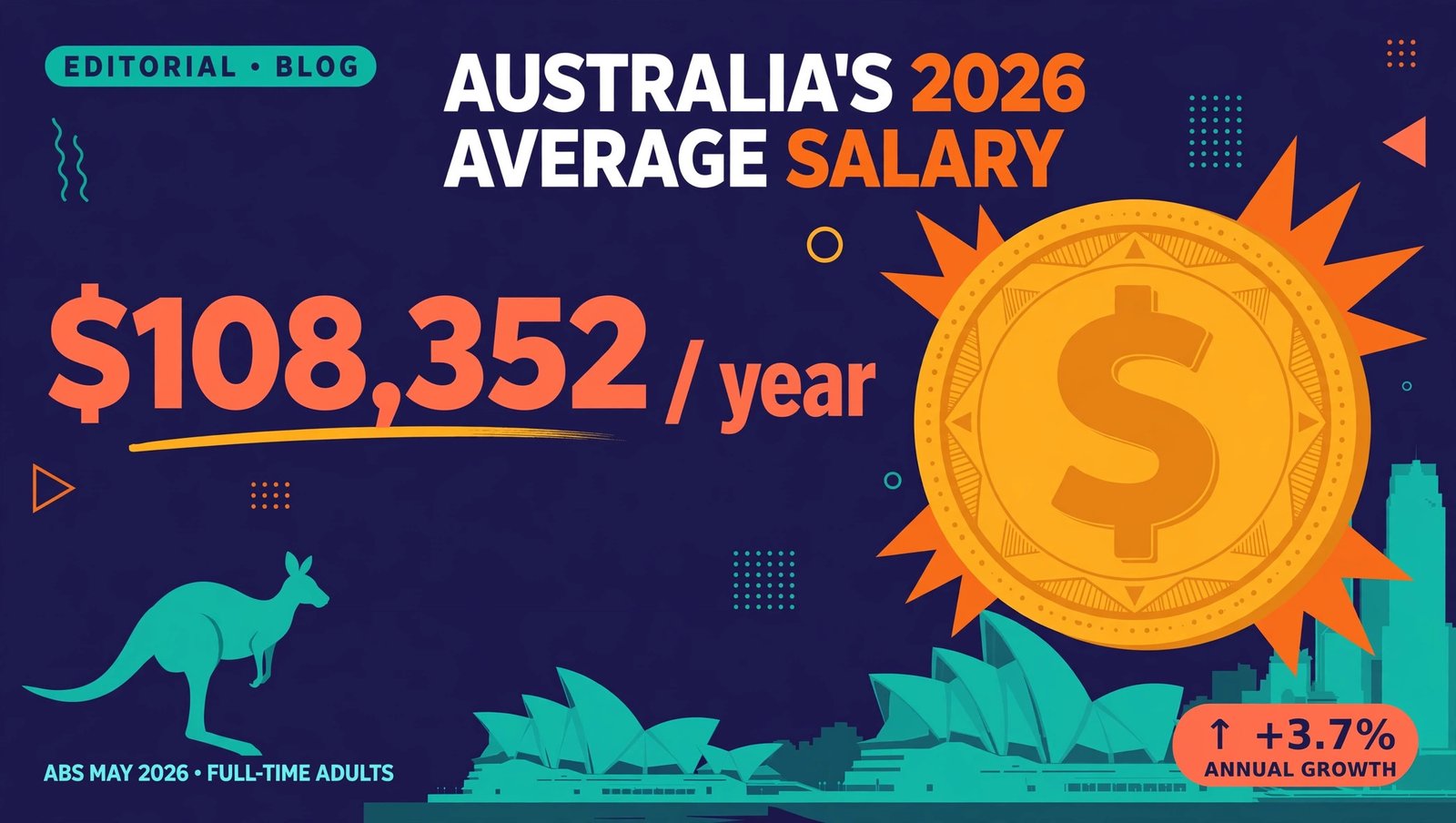
The average salary in Australia in 2026 is $108,352 a year — $2,083.70 a week — for full-time adults, according to the latest Australian Bureau of Statistics (ABS) Average Weekly Earnings release. But that headline number hides a big truth: most Aussies earn well below it. The median full-time worker takes home far less, the gender pay gap just hit a record low, and growth in earnings has slowed to its weakest pace in years. For the full picture, here is what Australians really earn in 2026 and what that pay is worth after tax.
Want your exact take-home pay?
The average salary is your gross figure — see what actually lands in your bank account with our free Australia take-home pay calculator, which handles the 2026-27 tax brackets, Medicare levy and super for you.
Average salary in Australia 2026: the headline figures
The ABS Average Weekly Earnings release for May 2026 (published August 2026) puts average weekly ordinary time earnings for full-time adults at $2,083.70 (seasonally adjusted) — which is $108,352 a year. Here are the key numbers from the same release, before tax:
- Full-time adults, ordinary time: $2,083.70/week → $108,352/year (up 3.7% on the year)
- Full-time adults, including overtime: $2,160.00/week → $112,320/year
- All employees (including part-timers): $1,579.20/week → $82,118/year
- Median, all employees: $1,425/week → $74,100/year (ABS Employee Earnings, August 2025)
- Median, full-time men: $1,841/week → $95,732/year
- Median, full-time women: $1,631/week → $84,812/year
One trend to know: earnings growth is slowing. Average weekly earnings grew just 1.6% in the six months to May 2026 — the lowest six-monthly growth since May 2022 — and the 3.7% annual figure is the lowest since November 2022. Public sector pay grew faster (2.3%) than the private sector (1.4%) over the half-year, and Queensland led the states with 2.5% growth.
Average vs median: why most Aussies earn less than $108,352
The average is pulled up by a relatively small number of very high earners — which is why the median is the more honest measure of where most workers sit. The ABS Employee Earnings survey (August 2025) puts median weekly earnings for all employees at just $1,425, or $74,100 a year. The Grattan Institute’s 2026 budget analysis puts it in plain terms: more than three-quarters of Australian workers earn less than the average full-time wage, the typical full-time worker actually earns around $100,000, and the typical worker (including part-timers) earns just $75,000.
At the bottom of the ladder, the national minimum wage in 2026 is $52,254.80 a year ($26.44 an hour) — less than half the average salary.
The gender pay gap hit a record low in 2026
The ABS reports the gender pay gap in average weekly ordinary full-time earnings fell to 11.3% — its lowest recorded point, down from 11.5% in November 2025. The underlying figures:
- Private sector: men $2,139.50/week vs women $1,840.80/week — a gap of about 14%
- Public sector: men $2,399.30/week vs women $2,154.00/week — a gap of about 10%
The gap is narrowing, but part of the difference reflects hours, not just pay rates: more women work part-time — about two in five female workers are part-time, compared to just one in five men — which pulls the overall medians apart ($87,000 typical for men vs $65,000 for women, per Grattan).
Industry and state differences: where the big pay gaps really are
Industry is the single biggest driver of pay differences in Australia. The ABS industry tables in the Average Weekly Earnings release consistently show mining and utilities at the top and hospitality and retail near the bottom — the spread between industries is far wider than the spread between states. In the latest release, the fastest-growing industry was transport, postal and warehousing (4.3% over six months), followed by wholesale trade (3.2%).
Across states, Queensland recorded the strongest six-monthly growth (2.5%), followed by the Northern Territory (2.2%) — but all states and industries recorded rises.
Is $100,000 a good salary in Australia in 2026?
Yes — by any national measure. $100,000 sits right on the typical full-time salary (Grattan puts the typical full-time worker at $100,000) and above the median, so it puts you comfortably above the midpoint of full-time earners. But its practical value depends heavily on where you live: in Sydney or Melbourne, after rent, it leaves limited breathing room, while in Brisbane, Adelaide or Perth the same salary goes meaningfully further. Whatever the salary, always count the 12% superannuation your employer pays on top — it is real income that headline comparisons often ignore.
Take-home pay on the average salary: what you actually keep
Gross pay is not what you keep. Through the 2026-27 resident tax rates (15% between $18,201 and $45,000, then 30%), plus the 2% Medicare levy, a $108,352 salary works out approximately as:
- Income tax: ≈ $23,026
- Medicare levy (2%): ≈ $2,167
- Total tax + levy: ≈ $25,193
- Take-home pay: ≈ $83,159 a year → ≈ $1,599 a week → ≈ $6,930 a month
These figures are approximate — your real take-home depends on deductions, offsets and other income. To get a personalised number, run it through our free Australia take-home pay calculator.
Super on the average salary: another $13,002 a year
On top of your wages, your employer must pay superannuation guarantee of 12% of your ordinary time earnings. On the average salary, that is 0.12 × $108,352 = ≈ $13,002 a year into your super fund — paid by your employer on top of your pay, not deducted from it. Since 1 July 2026, Payday Super rules mean employers must pay it at the same time as wages rather than quarterly.
Frequently asked questions
What is the average salary in Australia in 2026?
The average salary in Australia in 2026 is $108,352 a year ($2,083.70 a week) for full-time adults, based on the ABS Average Weekly Earnings release for May 2026. The median for all employees is much lower, at $74,100 a year.
Is $100,000 a good salary in Australia?
Yes — $100,000 sits at about the typical full-time salary and above the median, putting you comfortably above the midpoint of full-time earners. In Sydney or Melbourne it covers basics with limited savings margin; in Brisbane, Adelaide or Perth it goes further.
How much is the average Australian salary after tax?
A $108,352 salary in 2026-27 keeps approximately $83,159 after income tax and the 2% Medicare levy — about $1,599 a week or $6,930 a month. Your employer also pays about $13,002 a year in superannuation on top.
What is the gender pay gap in Australia in 2026?
The gender pay gap in average weekly ordinary full-time earnings fell to 11.3% in May 2026, its lowest recorded level. In the private sector, full-time men average $2,139.50 a week against $1,840.80 for women — a gap of about 14%.
Figures in this article are based on the ABS Average Weekly Earnings release (May 2026), ABS Employee Earnings (August 2025) and the Grattan Institute’s 2026 budget analysis. If you are due a rise, use our pay raise calculator to see exactly what a pay bump is worth — and if extra hours are boosting your pay, check what they add up to with our overtime pay calculator.