Mortgage Overpayment Calculator UK 2026
See what overpaying your UK mortgage really saves. Add a monthly overpayment or a one-off lump sum, choose whether to shorten the term or lower the payment, and check the 10% allowance so you never trigger an early repayment charge.
Your mortgage and overpayment
How the numbers compare
- Normal monthly payment: £0.00
- Total interest without overpayments: £0.00
- Total interest with overpayments: £0.00
- Total paid with overpayments: £0.00
- Mortgage-free without overpaying: —
- Mortgage-free with overpaying: —
Allowance and early repayment charge
- Overpaid in year 1: £0.00
- Penalty-free allowance: £0.00
- Amount over the allowance: £0.00
- Estimated charge at your ERC rate: £0.00
- Inside your allowance — no charge expected.
- Keep the share link — it reopens this exact calculation.
Your balance over time — with and without overpayments
Overpaying your mortgage is one of the highest-return uses of spare cash in the UK: every extra pound comes straight off the balance, so you are charged interest on less money for every remaining month. If you have not yet worked out your normal monthly payment, start with our UK mortgage calculator — then come back here to see what an overpayment adds.
How mortgage overpayments work — the simple formula
A UK repayment mortgage is worked out month by month. Each month your lender charges interest on the balance you still owe, then your payment clears that interest plus a slice of the balance. The normal monthly payment comes from the standard amortisation formula:
Monthly payment = balance × r × (1 + r)n ÷ ((1 + r)n − 1), where r is the annual rate divided by 12 and n is the number of months left.
An overpayment is simply extra money paid with that month’s payment. It goes straight off the balance, so next month’s interest is charged on a smaller amount — and because the balance falls faster, more of every later payment clears capital instead of interest. That compounding effect is why even a modest overpayment saves thousands: the saving grows every month the mortgage still runs.
Worked example 1 — £200 a month on a £200,000 mortgage
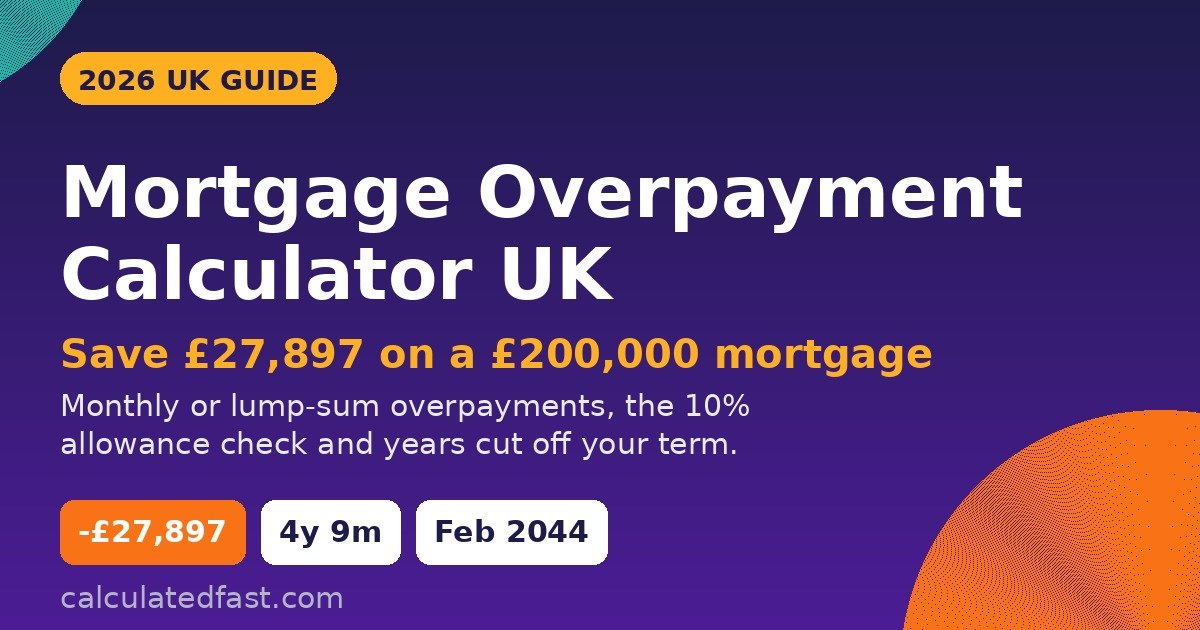
£200,000 balance, 4.5% rate, 22 years left, £200 a month overpaid. Normal payment £1,194.77 a month. Without overpaying you would pay £115,419.90 of interest and finish in November 2048. With the £200 overpayment you pay £87,522.42 of interest — £27,897.48 saved — and you are mortgage-free in February 2044, 4 years 9 months early. That is 57 fewer monthly payments of £1,194.77.
Worked example 2 — £300 a month on a £250,000 mortgage
£250,000 balance, 5.5% rate, 25 years left, £300 a month overpaid. Normal payment £1,535.22 a month. Total interest falls from £210,565.62 to £142,948.35 — £67,617.27 saved — and the mortgage ends 85 months early, in October 2044 instead of October 2051. Higher rates make overpaying even more valuable, because every pound of balance you clear avoids interest at that higher rate.
Worked example 3 — a £10,000 lump sum
£180,000 balance, 5% rate, 20 years left, £10,000 lump sum and no monthly overpayment. Normal payment £1,187.92 a month. The lump sum alone cuts total interest from £105,100.88 to £89,134.90 — £15,965.98 saved — and the mortgage ends 21 months early. A lump sum works best early in the term, when the balance — and therefore the interest charged each month — is at its largest.
Even £100 a month makes a real difference: on that £250,000 mortgage at 5.5% over 25 years, £100 a month saves £29,172.69 and finishes the mortgage 3 years early. The habit matters more than the size — start with what you can afford and raise it when pay rises land.
Shorten the term or lower the monthly payment?
Most UK lenders let you choose what an overpayment does. The two options give very different results, and the calculator above shows both:
| Choice | On £200,000 at 4.5%, 22 years, £200 a month | Best for |
|---|---|---|
| Shorten the term — payment stays £1,194.77 | Interest saved £27,897.48; mortgage-free 4 years 9 months early (Feb 2044) | Maximum saving; becoming mortgage-free sooner |
| Lower the payment — term stays 22 years | Interest saved £14,529.52; payment falls to £1,181.45 after 12 months and keeps drifting down — the final payment is just £56.28 | Freeing up monthly cash flow; lower outgoings now |
Shortening the term saves almost twice as much interest, because the balance is cleared faster and the higher payment keeps working. Lowering the payment is still worth doing if you need the breathing room — you save £14,529.52 and your required payment shrinks every month — but if you can afford the original payment, keep paying it and let the term shrink instead. Some lenders only offer one option, and some recalculate the payment once a year rather than every month, so ask yours which it is before you commit.
How much can I overpay on my mortgage each year?
Most UK fixed-rate, tracker and discounted deals let you overpay up to 10% of the outstanding balance each year with no charge. On a £200,000 mortgage that is £20,000 a year — far more than the £2,400 a year in the worked example above, which is only 1.2% of the balance. Some lenders are more generous: NatWest allows 20% a year, while others base the 10% on the original loan or on the balance at 1 January. The allowance usually resets each year and unused allowance does not carry over, so check your own mortgage offer for the exact figure and the date it resets.
Early repayment charges — what they cost
Go over your allowance while you are still inside a deal and your lender can charge an early repayment charge (ERC), usually 1% to 5% of the amount over the allowance, often tapering down each year of the deal — 5% in year one falling to 1% in the last year, for example. On a £200,000 mortgage with a 10% allowance, overpaying £25,000 in one year puts £5,000 over the limit; at a 3% ERC that costs £150 — small, but it eats into the saving, so the calculator checks your year-one overpayments against your allowance and shows the estimated charge. Once your deal ends there is normally no ERC at all, which is why many people time a big lump sum for the month their fix finishes. MoneyHelper’s guide to mortgage interest rate options explains fixed, variable and tracker deals and the charges that come with each.
Overpay your mortgage or save the money?
Overpaying earns a guaranteed, tax-free return equal to your mortgage rate — 4.5% on the worked example. Compare that with a savings account: a 4% savings rate is worth only 3.2% after basic-rate tax, and only the first £1,000 of savings interest a year is tax-free for basic-rate taxpayers (£500 for higher-rate, £0 for additional-rate). On those numbers overpaying wins. But savings win when you might need the money back: overpayments are locked into your home, while savings stay accessible. The right order for most people is to keep three to six months of essential spending in an accessible savings pot first — our savings goal calculator can size that pot for you — then overpay with what is left. If your savings rate beats your mortgage rate after tax, saving first can be the better deal; compound interest works the same way in reverse, which is why the comparison is so close. And if you carry expensive debts such as credit cards, clear those before overpaying: their rates are far higher than any mortgage.
What the calculator assumes
The results assume a capital repayment mortgage at a single fixed rate for the whole remaining term, with interest charged monthly and overpayments starting now. Real mortgages change rate when a deal ends — the average standard variable rate was 7.13% in October 2026 against 5.93% for a two-year fix (Moneyfacts), and the Bank of England raised Bank Rate to 4% on 5 November 2026, so test your figures at a higher rate too. The Bank’s own November 2026 Monetary Policy Summary records the 8–1 vote for that rise. If you are still house-hunting and weighing how big a mortgage to take on, our guide to how much house you can afford in the UK works through salary multiples and deposits first.
Five tips before you overpay
- Check the allowance first. Read your mortgage offer or ask your lender — the 10% figure is typical, not universal.
- Keep an emergency fund. Three to six months of spending in savings before you lock money into the mortgage.
- Overpay early in the term. The same £200 saves far more with 22 years left than with 5.
- Time big lump sums. Just after a deal ends, or just after the allowance resets, avoids ERCs.
- Do not overpay instead of a pension. Pension contributions get tax relief and employer matching that an overpayment cannot match — weigh both before you commit.
This calculator gives estimates for planning, not financial advice. Your lender’s terms, the timing of your overpayments and future rate changes all affect the real figures. If you are unsure, speak to a qualified mortgage adviser.
Frequently asked questions
How much can I overpay on my mortgage each year?
Most UK fixed-rate deals allow 10% of the outstanding balance a year with no charge — £20,000 on a £200,000 mortgage. Some lenders allow 20%. The exact allowance and the date it resets are in your mortgage offer, so check that before a large overpayment.
Does overpaying my mortgage reduce the term or the monthly payment?
It depends on what you ask your lender to do. Shortening the term keeps your payment the same and finishes the mortgage early — that saves the most interest. Lowering the payment keeps the term the same and shrinks what you pay each month. On a £200,000 mortgage at 4.5% with £200 a month overpaid, shortening the term saves £27,897.48 while lowering the payment saves £14,529.52.
Is it better to overpay my mortgage or save the money?
Overpaying earns a guaranteed tax-free return equal to your mortgage rate. Saving wins only if your savings rate beats your mortgage rate after tax — a 4% savings rate is 3.2% after basic-rate tax. Keep three to six months of spending in accessible savings first, then overpay with the rest.
What is an early repayment charge and how much is it?
An early repayment charge is a fee for repaying more than your allowance during a deal, usually 1% to 5% of the amount over the limit, often tapering each year. Overpaying £25,000 on a £200,000 mortgage with a 10% allowance puts £5,000 over the limit — at a 3% charge that is £150. There is normally no charge once the deal ends.
Can I make a lump-sum overpayment on my mortgage?
Yes. A lump sum goes straight off the balance and counts towards the same annual allowance as monthly overpayments. A £10,000 lump sum on a £180,000 mortgage at 5% with 20 years left saves £15,965.98 in interest and finishes the mortgage 21 months early.
Will overpaying my mortgage affect my credit score?
No — overpaying does not hurt your credit score, and it can help at remortgage time because a lower balance means a lower loan-to-value, which usually unlocks cheaper rates. Just keep the normal monthly payment covered and do not overpay money you may need back quickly.