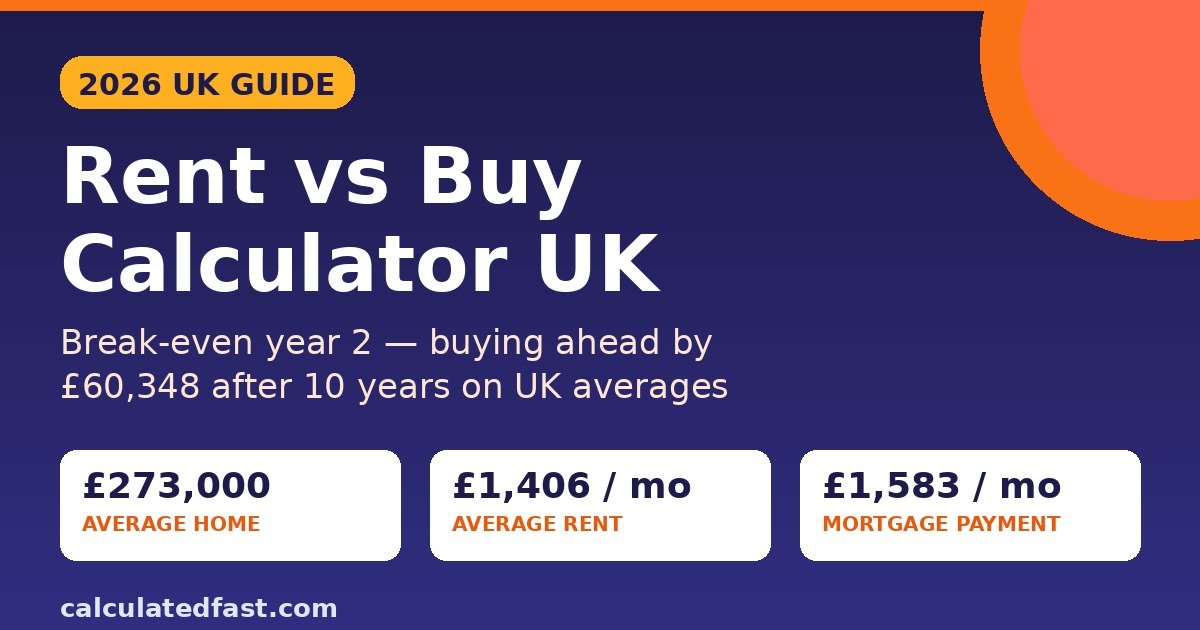
Should you rent or buy in the UK in 2026? Enter the home price, your rent and how long you would stay — and see which path leaves you better off, year by year, with your break-even year.
Compare renting and buying
Buying Renting and investing
How the rent vs buy calculator works
Asking whether it is better to rent or buy in the UK in 2026 is really asking two questions at once: what does each path cost month to month, and what are you left with at the end? This calculator answers both. It follows the money on two paths over the same number of years — buying a home with a repayment mortgage, or renting the same kind of home and investing the money you would otherwise have spent on a deposit. At the end of each year it compares the net wealth each path leaves you with, and it tells you the break-even year: the first year buying pulls ahead of renting.
The defaults are UK averages, so the answer you get first is the answer for a typical buyer: a £273,000 home (the ONS average for August 2026), a 10% deposit, a 6% mortgage over 25 years, and £1,406 a month in rent (the ONS average private rent for September 2026). Change any number to your own situation — your rent, the price of the home you are actually looking at, the rate on your mortgage offer — and the comparison re-runs instantly.
The formula, in plain English
Most rent vs buy comparisons only add up the monthly payments, which flatters renting: rent is usually cheaper than a mortgage payment in the first month. The honest comparison is wealth, not monthly cost. Buying builds equity — every mortgage payment chips away at the loan while the home itself (usually) rises in value — while renting keeps your deposit free to invest.
Renting net wealth = deposit + stamp duty + buying costs, invested at your chosen return.
Break-even year = the first year the buying figure is bigger than the renting figure.
Each month, the calculator works out what owning costs (mortgage payment plus maintenance) and what renting costs that month, with rent rising at your rent-growth rate. If owning costs more than renting that month, the buyer is behind by the difference; if renting costs more, the buyer banks the difference. Those monthly differences are invested at your investment return, so the gap compounds over time. The renter, meanwhile, starts with the whole upfront sum — deposit, stamp duty and buying costs — invested from day one. Stamp duty is calculated from the 2026/27 England and Northern Ireland bands, with first-time buyer relief applied when you tick the box.
Worked example: a £273,000 home vs £1,406 rent
Take the defaults. A £273,000 home with a 10% deposit means a £27,300 deposit and a £245,700 mortgage. At 6% over 25 years the mortgage payment is £1,583.05 a month. As a first-time buyer you pay £0 stamp duty on a £273,000 home, and with £2,000 of buying costs the cash you need upfront is £29,300. In the first month, owning costs £1,583.05 plus £227.50 of maintenance — £1,810.55 against £1,406 of rent — so renting is cheaper month to month by about £405.
But the wealth picture flips fast. House prices growing at 2% a year work on the full £273,000, not just your deposit — that leverage is the buyer’s biggest advantage. After 10 years the home is worth £332,785, the mortgage is down to £187,597, and you have paid £131,863 of interest and £58,103 of capital. Buying leaves you with £104,030 of net wealth, against £43,681 for renting and investing — buying is ahead by £60,348, and it first pulls ahead in year 2. Over the same 10 years you would have paid £193,419 in rent and kept nothing at the end of it. Before you borrow, check what the monthly payment does to your budget with our UK Mortgage Calculator, and check the rent side with our Rent Affordability Calculator.
Same home, different buyer: a £350,000 first home
On a £350,000 home with a 10% deposit and £1,600 rent, the mortgage payment is £2,029.55 a month and first-time buyer stamp duty is £2,500 (5% of the £50,000 above £300,000), so the upfront cash is £39,500. Break-even comes in year 4, and after 10 years buying is ahead by £40,621 (£99,509 against £58,888). The higher price and higher stamp duty push the break-even year out — which is why the same calculator can give a very different answer for a London flat than for a home in the North East, where the ONS average is far below £273,000.
Stamp duty in 2026/27
Stamp Duty Land Tax (SDLT) applies in England and Northern Ireland. Scotland charges Land and Buildings Transaction Tax and Wales charges Land Transaction Tax, so this calculator’s stamp duty figure covers England and Northern Ireland only. The rates below have applied since 1 April 2025 and were unchanged by the Autumn Budget 2026.
| Slice of the price | Standard rate | First-time buyer (home £500,000 or less) |
|---|---|---|
| Up to £125,000 | 0% | 0% up to £300,000 |
| £125,001 to £250,000 | 2% | 0% up to £300,000 |
| £250,001 to £925,000 | 5% | 5% on £300,001 to £500,000 |
| £925,001 to £1.5 million | 10% | No relief above £500,000 |
| Above £1.5 million | 12% | No relief above £500,000 |
A home mover buying the average £273,000 home pays £3,650 in stamp duty; a first-time buyer pays nothing. On a £350,000 first home the bill is £2,500, against £7,500 for a mover — a £5,000 saving. Our stamp duty on a £300,000 house guide works through the first-time buyer, mover and second-home figures in full.
What moves the answer most
The break-even year is not a fixed fact about renting and buying — it is a creature of your assumptions, and some matter far more than others. Run the same £273,000 defaults and change one thing at a time:
| Change one assumption | Break-even year | Buying ahead by (after 10 years) |
|---|---|---|
| Mortgage rate 5% instead of 6% | Year 2 | £87,916 |
| Mortgage rate 7% instead of 6% | Year 4 | £32,139 |
| House prices flat (0% growth) | Year 10 | £4,702 |
| House prices up 4% a year | Year 1 | £126,982 |
| Rent rising 5% a year | Year 2 | £81,565 |
| Investment return 5% instead of 4% | Year 3 | £53,354 |
| Maintenance 1.5% instead of 1% | Year 3 | £42,127 |
House price growth is the single biggest lever: at 0% growth, buying barely breaks even even after a decade, because the buyer’s advantage is almost entirely leverage on the home’s value. The mortgage rate is next — a single percentage point moves the 10-year gap by nearly £28,000. That is why the October 2026 rate picture matters so much: the Moneyfacts average five-year fix hit 6.00% on 5 October 2026, the highest in about three years, while best-buy deals at 60% loan-to-value were around 4.9% to 5.1%. Enter the rate on your own mortgage offer, not the average — a bigger deposit that unlocks a cheaper rate changes the answer twice over.
What the calculator leaves out
No calculator can price everything, and it is better to know the gaps than to pretend they are not there. Council tax is left out because owners and renters both pay it. Buildings and contents insurance, service charges and ground rent on leasehold flats, and mortgage arrangement fees are not in the model — add them to the maintenance or buying-costs boxes if they are large for you. The investment return is shown before tax; in practice a stocks and shares ISA shelters up to £20,000 a year, but gains outside an ISA can be taxed. The model assumes you sell at the end of your stay and pay the selling costs then; if you stay put, those costs never arise and buying looks better still. And it assumes rents and prices grow smoothly every year — in real life they do not.
Five ways to make buying win sooner
- Stay longer. The upfront costs — stamp duty, legal fees, moving — are spread over more years, and equity compounds. A two-year stay is borderline at UK averages; a ten-year stay is decisive.
- Put down a bigger deposit. It cuts the loan, the monthly payment and usually the rate itself, since cheaper deals start at lower loan-to-value bands.
- Buy below the average. Stamp duty, maintenance and the deposit all scale with price. A £200,000 home breaks even years earlier than a £400,000 one on the same rent.
- Overpay the mortgage when you can. Extra payments cut the interest bill directly — check your lender’s overpayment allowance first, usually 10% of the balance a year without penalty.
- Check your salary can carry it. Lenders typically lend 4 to 4.5 times your salary. Our how much house can I afford guide works through the multiples, and our UK Take-Home Pay Calculator shows what your salary is actually worth each month after tax.
Ready to check the monthly payment? Run your price, deposit and rate through our UK Mortgage Calculator — including the overpayment mode that shows how much interest an extra £200 a month saves.
Disclaimer: this calculator gives planning estimates from the assumptions you enter. It is not financial advice and not a prediction — house prices and rents can fall as well as rise, and mortgage rates change. The figures use ONS averages for August and September 2026 and the SDLT bands in force since 1 April 2025. Sources: ONS: Private rent and house prices, UK (October 2026) and GOV.UK: Stamp Duty Land Tax. For a decision of this size, speak to a qualified mortgage adviser.
Rent vs buy — frequently asked questions
Is it better to rent or buy in the UK in 2026?
At UK averages — a £273,000 home, 10% deposit, 6% mortgage and £1,406 rent — buying pulls ahead in year 2 and leaves you about £60,000 better off after 10 years. But the honest answer depends on how long you stay, the rate you can actually get and whether house prices rise. If you might move within two years, renting usually wins; if you will stay put for a decade, buying usually wins by a wide margin.
How long do I need to stay for buying to be cheaper?
The break-even year is the first year buying leaves you with more net wealth than renting. On the calculator’s defaults it is year 2. A higher mortgage rate pushes it later — 7% instead of 6% moves it to year 4 — and flat house prices push it all the way to year 10. Enter your own numbers to find your break-even year.
How much deposit do I need to buy a house in the UK?
Most lenders ask for at least 10% of the price — £27,300 on the average £273,000 home — and 5% deposit mortgages exist for some buyers. A bigger deposit usually unlocks a cheaper mortgage rate, so saving 15% or 20% can change the comparison twice over: a smaller loan and a lower rate on it.
What stamp duty do first-time buyers pay in 2026?
In England and Northern Ireland, first-time buyers pay no stamp duty on the first £300,000 of a home costing £500,000 or less, and 5% on the part from £300,001 to £500,000. Above £500,000 the relief disappears entirely and the standard rates apply to the whole price. A first-time buyer pays £0 on a £273,000 home and £2,500 on a £350,000 home.
Does the calculator include maintenance and selling costs?
Yes. Maintenance defaults to 1% of the home’s value a year, and selling costs default to 2% of the sale price (estate agent and legal fees). Both are editable. Insurance, service charges and ground rent on flats are not included — add them to the maintenance box if they apply to you.
Should I buy if I might move in two years?
Probably not. Stamp duty, legal fees, survey and moving costs are paid upfront and need time to pay for themselves through equity and price growth. At UK averages the break-even year is 2, so a two-year stay is right on the edge — and any fall in prices or a higher rate tips it back to renting. If a move is likely, renting keeps your deposit free and your options open.
Own already? If you have a mortgage, our Mortgage Overpayment Calculator UK shows what an extra £200 a month saves in interest and years.