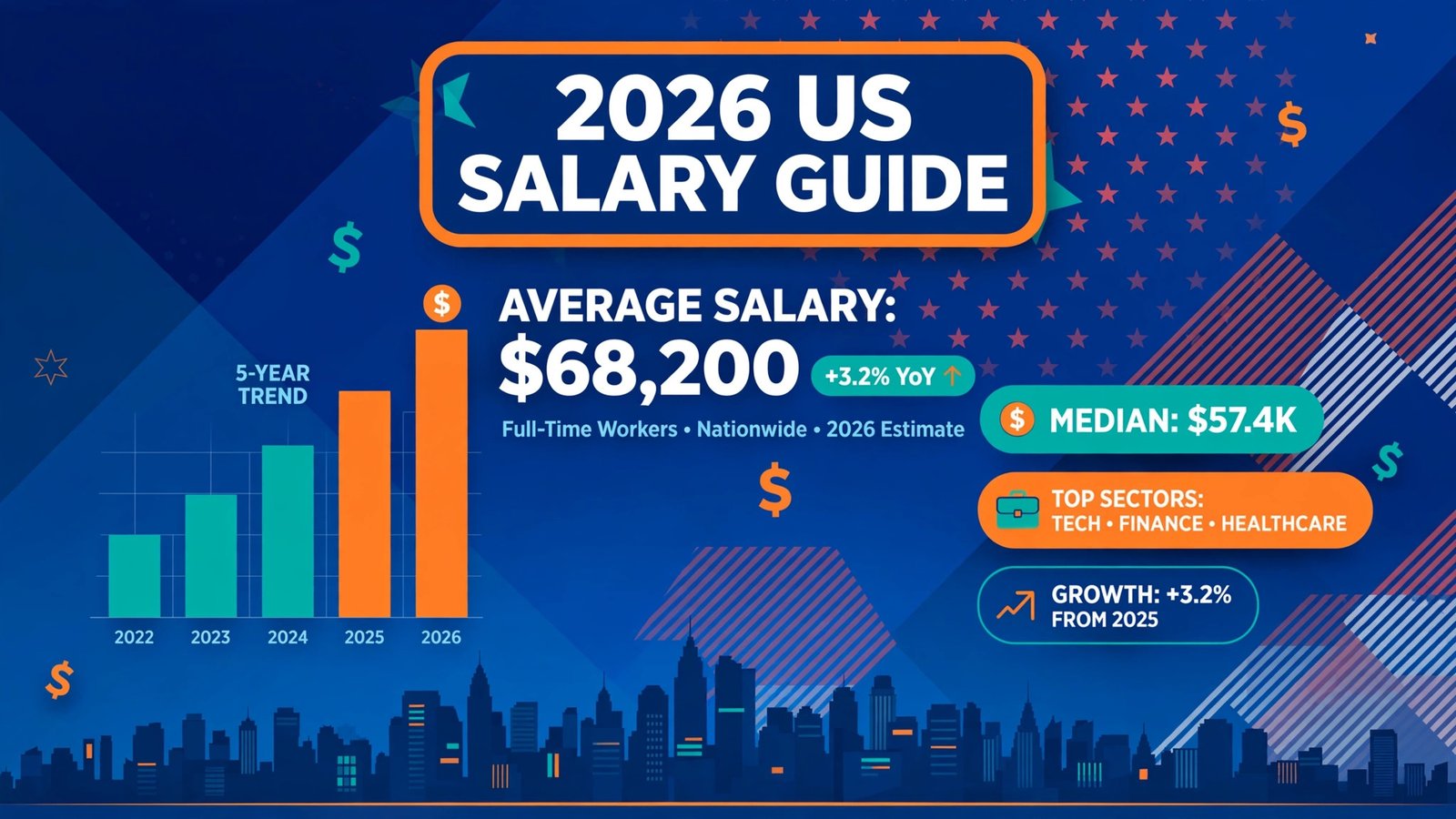
2026 US Salary Guide
Average Salary in the US in 2026: What Americans Really Earn
The short answer: the average American salary in 2026 is about $63,795 a year, while the median full-time worker earns $1,251 a week — roughly $65,052 a year, according to the Bureau of Labor Statistics. The rest of this guide breaks those numbers down by age, state, and gender — and shows what the average actually leaves in your pocket after tax.
Earning around the average? See exactly what it means after tax.
Calculate Your US Take-Home Pay →Federal + FICA for 2026 · takes 30 seconds
The phrase “average salary” gets thrown around constantly, but the number behind it decides whether your own pay is ahead or behind — and whether your salary is actually keeping up with inflation. The headline figures for 2026: the mean annual wage across all US occupations sits around $63,795, while the median full-time worker earns $1,251 per week ($65,052 a year), up 4.6% from a year earlier according to the Bureau of Labor Statistics quarterly earnings release published in July 2026. Monthly reporting paints a similar picture: the average weekly wage stood at $1,301 in September 2026, per USAFacts data drawn from the BLS.
That 4.6% nominal gain matters less than it looks: the Consumer Price Index rose 3.9% over the same period, so real wage growth was about 0.7% — a genuine but modest gain in purchasing power.
Average vs. median: which number actually matters?
The two figures answer different questions. The mean ($63,795/year) adds up every paycheck and divides by every worker — including part-time staff. The median ($65,052/year for full-time workers) is the middle of the pack: half of full-time workers earn more, half earn less.
For comparing your own pay, the median is the honest benchmark. If you work full time and earn $60,000, you’re not “below average” — you’re close to the middle of the country’s full-time workforce. And if you’re paid by the hour, the median translates to about $31.28 an hour ($1,251 ÷ 40), while the mean works out to roughly $30.67 an hour ($63,795 ÷ 2,080). Convert any rate yourself with our hourly-to-salary converter.
US salary by age in 2026
Earnings follow a clear peak-and-plateau curve. BLS data for the second quarter of 2026 shows pay rising steadily through your 30s, peaking in the 35–44 band, then flattening:
| Age group | Median weekly | ≈ Yearly |
|---|---|---|
| 16–19 | $678 | $35,256 |
| 20–24 | $831 | $43,212 |
| 25–34 | $1,160 | $60,320 |
| 35–44 | $1,436 | $74,672 |
| 45–54 | $1,421 | $73,892 |
| 55–64 | $1,367 | $71,084 |
| 65+ | $1,233 | $64,116 |
The 35–44 group is the national peak at $74,672 a year — nearly double what the typical 20–24-year-old earns. If you’re in your late 20s earning $60,000, you’re right on the median for your age band and your trajectory is pointing up.
US salary by state: where you live changes everything
A $63,795 salary in rural Mississippi and the same salary in Boston are entirely different economic realities. Average annual salaries range from roughly $51,200 in Mississippi to about $76,600 in Massachusetts — nearly 50% higher in the top state, driven by biotech, finance, and tech employment around Boston. New York, California, and Washington cluster near the top, while Arkansas and West Virginia sit near the bottom.
But the headline ranking hides the real question: what does a dollar actually buy there? Once you adjust for cost of living, states like Texas — with no state income tax and lower housing costs — often deliver more purchasing power than the coastal leaders. A “lower” salary in a low-cost state can easily be the richer deal.
The pay gaps: gender and race
In the second quarter of 2026, women working full time earned a median of $1,131 a week — 82.0% of the $1,380 median for men. That $249-a-week gap compounds to about $12,948 a year. The gap narrowed slightly over the year (women’s earnings rose 4.9% vs. 3.8% for men), but it remains substantial.
The picture also varies by race and ethnicity among full-time workers: Asian workers earned a median of $1,713 a week, White workers $1,268, Black workers $1,029, and Hispanic workers $997. Within those groups, women’s-to-men’s ratios ranged from 78.3% for Asian women to 91.0% for Black women.
What does the average salary mean for your take-home pay?
Gross salary is not what hits your bank account. A single filer with no state tax earning the full-time median of $65,052 keeps roughly $54,000 a year after federal income tax and FICA — about $4,508 a month, or an effective tax rate of around 17%. (Illustrative estimate using 2026 brackets; your state tax can shift this by several thousand dollars either way.)
That monthly figure is the one to compare against your actual life: rent, loan payments, savings. Run your own numbers — including your state — in our US paycheck calculator. And if a raise is on the table, see exactly what an extra few percent means with the pay raise calculator — in 2026, anything below about 3.9% means a real-terms pay cut.
Is the average salary keeping up with inflation?
This is the test that matters most. Over the year to Q2 2026, median full-time earnings rose 4.6% while the CPI-U rose 3.9% — so the typical worker gained roughly 0.7% in real purchasing power. That’s a meaningful improvement over the years when wages lagged inflation, but it’s still far from a boom: prices are up dramatically from the early 2020s, and real gains only just returned to positive territory.
If your own raise this year came in below 3.9%, your salary quietly lost ground — even if the number on your paycheck went up.
Frequently asked questions
What is the average salary in the US in 2026?
The mean annual wage across all US occupations is about $63,795, while the median full-time worker earns $1,251 a week ($65,052 a year), per the Bureau of Labor Statistics.
What is a good salary in the US in 2026?
Anything above the 35–44 peak median of $74,672 a year puts you in the top half of your age group nationally — but “good” depends heavily on your state and cost of living.
How much does the average American take home after tax?
A single filer with no state tax earning the $65,052 median keeps roughly $54,000 a year after federal tax and FICA — about $4,508 a month.
Which US state pays the highest average salary?
Massachusetts leads at roughly $76,600 a year, driven by biotech, finance, and technology; Mississippi is the lowest at about $51,200.
What is the gender pay gap in the US in 2026?
Women working full time earn a median of $1,131 a week — 82.0% of the $1,380 men’s median, a gap of about $12,948 a year (BLS, Q2 2026).
Is $65,000 a good salary in 2026?
Yes — $65,000 is essentially the median full-time salary, so you’re earning more than half the country’s full-time workforce. In a low-cost state it’s comfortable; in a coastal metro it can feel tight.
Sources
Figures are from the Bureau of Labor Statistics “Usual Weekly Earnings of Wage and Salary Workers” release for Q2 2026 (published July 21, 2026) and September 2026 average-weekly-wage reporting via USAFacts, cross-checked against state-level 2026 salary reporting.